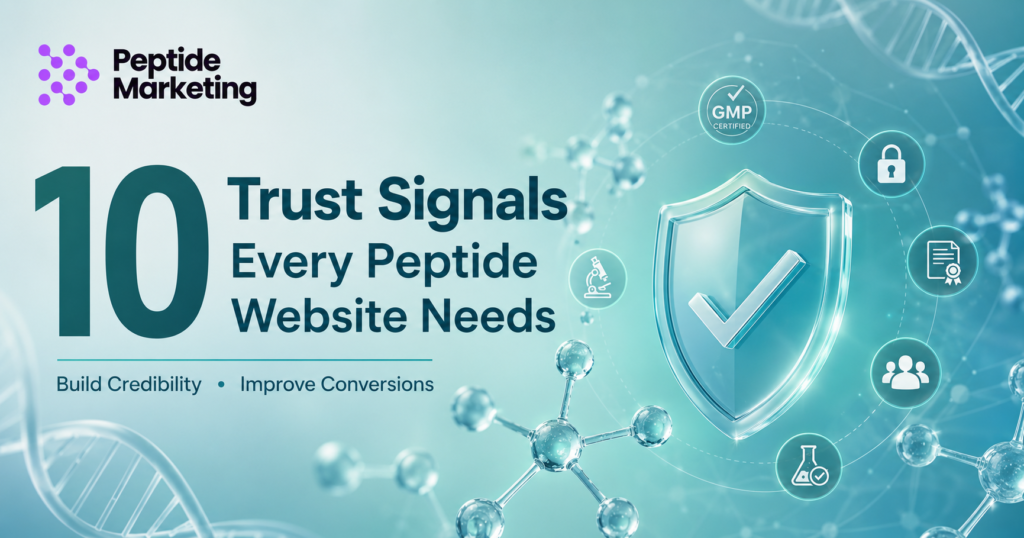
Peptide website trust signals are the visible details that help visitors decide whether a company appears credible, transparent and professional.
A potential customer may arrive through Google, social media, an advertisement or a recommendation. Before reading every product description or company policy, that visitor will form an opinion about the business.
Does the website look professional? Is the company easy to contact? Can visitors find quality information? Does the website explain what it offers clearly?
When these questions are not answered, visitors may leave even when the company provides excellent products or services.
This is one of the main reasons many peptide websites fail to convert visitors. Increasing traffic will not solve the problem when the website does not create enough confidence.
Here are ten trust signals every peptide website should include.
Why Trust Matters for Peptide Companies
Trust influences nearly every stage of the customer journey.
A visitor may discover a company through Peptide SEO, read an educational article, visit a product page and review the company’s policies before taking action.
Every page either strengthens or weakens confidence.
For peptide companies, visitors may want more information than they would expect from an ordinary ecommerce store. They may look for clear product descriptions, quality documentation, company information, contact options and transparent policies.
A website should make these details easy to find.
Trust does not come from adding one badge or writing “premium quality” above the fold. It comes from the complete website experience.
1. Professional and Consistent Website Design
The visual quality of a website affects how visitors perceive the business.
A professional peptide website should use:
- Consistent colors and typography
- Clear spacing
- Readable text
- High quality images
- Simple navigation
- A recognizable brand identity
- Consistent button styles
- A clean mobile layout
Professional design does not mean filling every section with animations, glowing effects and scientific graphics.
A website can look modern without becoming visually overwhelming.
The design should direct attention toward the company’s message, products, services and calls to action.
Professional Peptide Website Design and Development should make the business easier to understand, not simply make the website more decorative.
2. Clear Company Information
Visitors should be able to understand who operates the website.
A strong About page can explain:
- What the company does
- Who it serves
- When it was established
- Where it operates
- What makes it different
- Who is behind the business
- How customers can contact the team
Generic descriptions such as “we are committed to quality and innovation” are not enough on their own.
Specific information feels more credible.
Explain the company’s experience, process, values and approach in language that sounds human rather than copied from a corporate template.
Consistent company information also helps search engines and AI systems understand the business as one clear entity.
For your website, the official brand should always be written as Peptide-Marketing.
3. Visible Contact Details
Visitors should not have to search through multiple pages to find a way to contact the company.
Include relevant contact options such as:
- Business email
- Contact form
- Phone number
- Business location where appropriate
- Customer support hours
- Social media profiles
The footer and Contact page are natural places for this information.
If the company serves customers internationally, explain expected response times and the regions supported.
Visible contact information reassures visitors that a real business is available when they need help.
It can also improve lead generation because potential customers are more likely to inquire when the process feels simple.
4. Transparent Testing and Quality Information
Quality information should be easy to find where it is relevant to the business.
Depending on the type of peptide company, this may include:
- Testing procedures
- Purity information
- Quality control processes
- Laboratory details
- Batch information
- Product documentation
- Manufacturing standards
- Storage information
Avoid vague claims that provide no supporting detail.
Instead of saying only that products are “high quality,” explain how quality is evaluated and what documentation is available.
Technical information should be presented clearly enough that both knowledgeable and less technical visitors can understand its importance.
A short summary can appear first, followed by more detailed information for visitors who want it.
5. Certificates of Analysis Where Applicable
Certificates of analysis can be an important trust signal when they are relevant to the products being offered.
If the company provides COAs, visitors should be able to locate them without unnecessary difficulty.
Useful practices may include:
- Linking the document from the product page
- Showing the related batch or lot information
- Keeping documents current
- Making files easy to read on mobile
- Explaining what the information means
- Avoiding broken or inaccessible document links
A COA should support transparency rather than act as a decorative badge.
Do not publish documents that contain sensitive information that should remain private. Review what is displayed before uploading anything publicly.
6. Clear Policies and Disclaimers
Website policies help set expectations and reduce uncertainty.
Important pages may include:
- Shipping policy
- Return and refund policy
- Privacy policy
- Terms and conditions
- Cookie information
- Product related disclaimers
- Contact and support policy
These pages should be easy to find in the footer and written clearly.
Avoid hiding important terms inside long paragraphs that are difficult to understand.
Policies should reflect the company’s actual operations. Copying policy language from another website can create inaccurate or contradictory information.
Clear policies support both credibility and customer service.
They also help visitors understand what will happen before, during and after a purchase or inquiry.
7. Secure Website Functionality
A visitor should feel confident submitting information or completing a transaction.
At a minimum, the website should use HTTPS and display no browser security warnings.
Other important areas include:
- Secure checkout
- Reliable payment processing
- Protected contact forms
- Updated software
- Regular backups
- Spam protection
- Clear privacy information
- Working links and buttons
Security also affects first impressions.
Broken pages, expired certificates, checkout errors and forms that do not submit can make a legitimate company appear unreliable.
Website maintenance should be treated as an ongoing activity rather than a one time project.
8. Helpful Product and Service Information
Thin product pages can make visitors uncertain.
A strong product page should provide the information needed to make an informed decision.
That may include:
- Clear product name
- Unique description
- Relevant specifications
- Quality information
- Supporting documentation
- Shipping details
- Storage information where applicable
- Frequently asked questions
- Related products
- A clear purchase option
Service pages should explain:
- What the service includes
- Who it is for
- Which problem it addresses
- How the process works
- What the next step is
This is also important for organic visibility. Peptide SEO differs from traditional SEO because technical terminology, educational content, trust and search intent must work together.
9. Educational Content and Frequently Asked Questions
Educational content helps visitors understand the company’s products, services and industry.
Useful content can include:
- Beginner guides
- Product explanations
- Glossary pages
- Frequently asked questions
- Comparison articles
- Process explanations
- Case studies
- Videos
- Checklists
A blog should not exist only to attract search traffic.
Each article should answer a genuine question and connect to a relevant product, service or next step.
For example, What Is Peptide Marketing? introduces the complete marketing process, while How to Market a Peptide Company explains how websites, SEO, social media, email and conversion work together.
Frequently asked questions are especially useful because they address concerns that may prevent someone from taking action.
Use questions your audience actually asks rather than creating FAQs only to insert keywords.
10. Authentic Reviews, Case Studies and Proof
People are more likely to trust a business when they can see evidence of real experience.
Useful proof may include:
- Verified customer reviews
- Client testimonials
- Detailed case studies
- Before and after examples
- Screenshots
- Measurable results
- Business partnerships
- Relevant certifications
- Original research
Avoid unsupported claims or testimonials that sound artificial.
A strong case study should explain the original problem, what was changed, the timeframe and the outcome.
When presenting marketing results, clarify whether the result came from one client, an average or a specific campaign.
For peptide service providers, case studies can help potential clients understand how the company approaches real business problems.
Bonus Trust Signal: Clear Calls to Action
Trust and conversion are closely connected.
Once a visitor understands the company and feels confident, the next step should be obvious.
Calls to action may include:
- View Products
- Request a Quote
- Contact the Team
- Book a Consultation
- Download a Guide
- Join the Email List
- View Testing Information
Each page should have one primary action.
Too many competing buttons can create confusion.
Conversion Rate Optimization can help identify where visitors hesitate, which pages lose attention and how the customer journey can be improved.
Common Peptide Website Trust Mistakes
Some of the most common problems include:
- Inconsistent branding
- No About page
- Hidden contact information
- Generic product descriptions
- Outdated quality documents
- Missing website policies
- Broken links
- Slow mobile performance
- Unsupported claims
- No clear next step
These issues may appear small individually, but together they can make the entire website feel incomplete.
Before spending more on advertising or social media, review whether the website is ready to convert the traffic it already receives.
Social Media Marketing can introduce people to the brand, and Email Marketing can continue the relationship, but the website must still provide a trustworthy destination.
Peptide Website Trust Checklist
Review your website using these questions:
- Is the company name consistent everywhere?
- Does the homepage explain what the business offers?
- Are contact details easy to find?
- Are policies visible?
- Is the website secure?
- Is testing or quality information accessible where relevant?
- Are product and service pages detailed?
- Does the website work properly on mobile?
- Are claims supported?
- Is the next action clear?
Every unclear answer represents a potential improvement.
Frequently Asked Questions
What are peptide website trust signals?
Peptide website trust signals are visible elements that help visitors evaluate the credibility, professionalism and transparency of a peptide company. Examples include clear company details, secure browsing, quality documentation, helpful content and transparent policies.
Why are trust signals important?
Trust signals reduce uncertainty. They help visitors feel more comfortable exploring products, sharing information, contacting the company or completing a purchase.
Can better trust signals improve conversions?
Yes. Trust signals can improve conversions by answering important questions and reducing hesitation. However, they should be supported by good usability, clear messaging and a relevant offer.
Does website design affect credibility?
Yes. Inconsistent branding, poor mobile usability, broken pages and confusing layouts can damage confidence. Professional design helps information feel organized and accessible.
Where should trust signals appear?
Trust signals should appear throughout the customer journey. Relevant information can be placed on the homepage, product pages, service pages, checkout, footer, About page and Contact page.
Build a More Trustworthy Peptide Website
A trustworthy peptide website does more than look attractive.
It clearly explains the business, provides useful information, supports important claims and makes it easy for visitors to take the next step.
Peptide-Marketing helps peptide companies improve website structure, SEO, content, credibility and conversion paths.
Does Your Peptide Website Inspire Confidence?
Peptide-Marketing can review your website’s design, trust signals, content and customer journey to identify the improvements that could have the greatest impact.