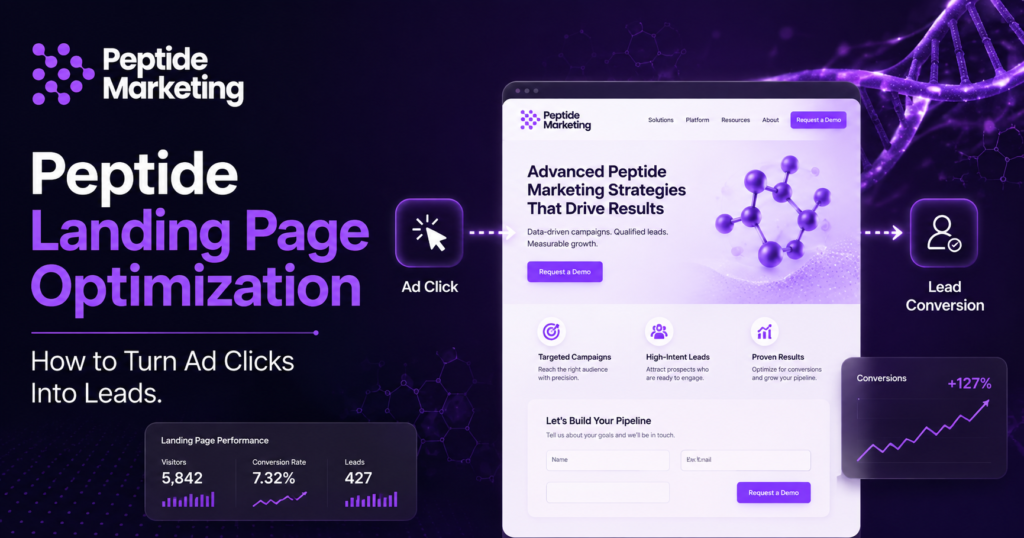
Peptide landing page optimization is the process of improving a landing page so more relevant visitors understand the offer, trust the business and complete the intended action.
That action might be purchasing a product, requesting information, joining an email list or booking a consultation.
Getting more traffic is only part of the job. If visitors click an advertisement or search result and arrive on a confusing page, additional traffic can simply create additional lost opportunities.
A strong peptide landing page connects the message that attracted the visitor with a clear, trustworthy and easy next step.
If your company is already investing in advertising, start with our guide on Why Peptide Ads Get Rejected on Meta and Google before optimizing the page itself.
What Is Peptide Landing Page Optimization?
Peptide landing page optimization focuses on improving the page visitors reach after clicking an advertisement, social post, email or search result.
The goal is not to fill the page with more content.
The goal is to remove uncertainty.
A visitor should quickly understand:
- What is being offered
- Who the offer is for
- Why the company is credible
- What information matters
- What they should do next
A well-designed landing page combines messaging, design, trust, performance and conversion strategy.
That is why Conversion Rate Optimization for Peptide Brands should work alongside your advertising and website strategy rather than being treated as a separate activity.
Why Ad Clicks Do Not Automatically Become Leads
A successful advertisement creates interest.
It does not automatically create trust.
After clicking, the visitor starts evaluating the business.
They may ask:
- Does this page match what I clicked?
- Is this company legitimate?
- Can I understand the offer quickly?
- Where can I find more information?
- Is the website easy to use?
- What happens if I contact the company?
- What should I do next?
When a page fails to answer those questions, visitors may leave even when the advertisement itself performed well.
This is one reason many peptide websites fail to convert visitors.
Increasing advertising spend before fixing the page can make the problem more expensive.
1. Match the Landing Page With the Advertisement
The first rule is simple.
The landing page should continue the conversation started by the advertisement.
If an advertisement promotes a website audit, the visitor should arrive on a page about the website audit.
If an advertisement promotes SEO, the destination should clearly explain SEO.
If the ad promises a specific resource, the resource should be immediately visible.
Avoid sending every advertisement to the homepage.
A homepage serves several audiences and purposes. A landing page should usually focus on one campaign, one audience and one primary action.
For peptide businesses running paid campaigns, your Meta and Google Ads strategy and landing page should therefore be planned together.
For Google Ads specifically, you can also compare your destination against Google’s official Destination Requirements, which focus on destinations being functional, useful and easy to navigate.
2. Make the Main Message Clear Above the Fold
The top section of the page should answer the most important question:
Why should this visitor stay?
A strong opening section usually needs:
- One clear headline
- A short supporting explanation
- One primary call to action
- A relevant visual
- An immediate trust signal where appropriate
Avoid trying to explain the entire company in the hero section.
For example, instead of:
Advanced Growth Solutions for Modern Businesses
use something specific:
Peptide SEO Designed to Attract High Intent Search Traffic
Specific language helps visitors recognize that they reached the right page.
Professional Peptide Website Design and Development should make this message obvious without forcing visitors to search through several sections.
3. Add Trust Before Asking for Action
Visitors are less likely to submit information when the business feels difficult to verify.
Trust signals should appear before and around important conversion points.
Depending on the page, these may include:
- Clear company information
- Contact details
- Relevant case studies
- Authentic testimonials
- Transparent policies
- Quality information where applicable
- Secure website functionality
- Professional branding
- Relevant business experience
- Frequently asked questions
The exact trust signals should match what the visitor needs to evaluate.
A customer buying a product may need different reassurance from a business owner booking a marketing consultation.
Use our 10 Trust Signals Every Peptide Website Needs as a checklist when reviewing your page.
4. Remove Unnecessary Distractions
A landing page is not the place to present every service, blog, social profile and company announcement.
Too many choices can weaken the main conversion path.
Review the page for unnecessary elements such as:
- Multiple competing calls to action
- Large menus with unrelated pages
- Excessive animations
- Long blocks of text
- Unrelated offers
- Repeated popups
- Decorative elements that hide important information
Each campaign page should have one clear primary objective.
A visitor should know what the next step is without having to think about it.
You can still provide supporting information, but it should help the visitor make the main decision rather than pull them in several directions.
5. Make Mobile Performance a Priority
Many people will encounter an advertisement or social post on a phone and open the landing page on the same device.
A page designed only for desktop can create immediate friction.
Check:
- Headline size
- Button visibility
- Image dimensions
- Form fields
- Navigation
- Popups
- Page spacing
- Loading performance
- Content order
Buttons should be easy to tap, forms should be practical to complete and the main message should fit naturally on a smaller screen.
Google’s Core Web Vitals framework measures loading performance, responsiveness and visual stability, with recommended thresholds including an LCP of 2.5 seconds or less for a good experience.
Do not upload unnecessarily large featured images or background videos if they slow down the page without improving the visitor’s decision.
6. Use One Strong Call to Action
Every landing page needs a clear primary action.
Examples include:
Book a Consultation
Request a Quote
Get Your Website Audit
View Available Products
Download the Guide
Contact Our Team
The wording should tell visitors what happens next.
Generic buttons such as “Submit” or “Learn More” are often less informative.
Place the primary CTA:
- Near the top of the page
- After the main benefits
- After important trust information
- Near the bottom of longer pages
The action can appear several times, but the purpose should remain consistent.
7. Shorten Forms and Reduce Friction
A form should collect the information genuinely required for the next step.
If someone is requesting an initial consultation, asking for fifteen pieces of information before allowing them to speak with the company may create unnecessary friction.
A practical first form may request:
- Name
- Company
- Website
- Main challenge
More detailed information can be collected later.
For ecommerce pages, friction may instead appear in:
- Account creation
- Checkout steps
- Payment options
- Shipping information
- Error messages
The easier the next step is to understand and complete, the better the customer journey becomes.
8. Connect the Landing Page With Search Intent
Not every landing page visitor comes from paid advertising.
Some will arrive through organic search.
That means the page should also match the intent behind the keyword.
Peptide SEO can bring qualified visitors to the website, but the destination still needs to satisfy what they searched for.
For example:
A person searching peptide SEO services should find information about peptide SEO services.
A person searching peptide website development should reach a website-focused page.
A person searching what is peptide marketing needs educational information before they are ready for a service conversation.
This is why your wider What Is Peptide Marketing? guide and commercial landing pages serve different purposes.
9. Use Educational Content to Support the Decision
Not everyone who reaches a landing page is ready to act immediately.
Supporting content can answer questions without overcrowding the main page.
Useful internal resources might include:
- Educational guides
- Frequently asked questions
- Case studies
- Comparison articles
- Process explanations
- Relevant service pages
Your Peptide Content Marketing guide explains how educational content can support commercial pages instead of existing as an isolated blog strategy.
Use internal links where they genuinely help the visitor understand the next step.
Google recommends descriptive, relevant anchor text because it helps users understand the destination and gives search engines context about the linked page.
10. Follow Up With Visitors Who Are Not Ready
Even a strong landing page will not convert every visitor during the first session.
Some people need more time.
Give relevant visitors an opportunity to continue the relationship through:
- Email signup
- Downloadable guide
- Consultation reminder
- Retargeting
- Educational content
- Follow-up email
Peptide Email Marketing can help continue the conversation after a prospect leaves the page.
The landing page creates the initial opportunity.
Email and other follow-up channels help prevent that opportunity from disappearing completely.
Peptide Landing Page Optimization Checklist
Before sending traffic to your next landing page, check the following.
Message
- Does the page match the advertisement or search query?
- Is the main offer immediately clear?
- Is the headline specific?
Trust
- Is the company easy to identify?
- Are contact details available?
- Are relevant trust signals visible?
- Are important claims properly supported?
Conversion
- Is there one primary CTA?
- Is the form reasonably short?
- Does the visitor know what happens after submitting?
Mobile
- Does the page load properly?
- Is the headline readable?
- Are buttons easy to tap?
- Are images correctly sized?
- Do popups interfere with the page?
Measurement
- Is conversion tracking installed?
- Can you identify where leads came from?
- Are you measuring qualified leads rather than clicks alone?
Do not judge a landing page only by how attractive it looks.
Judge it by how clearly it helps the right visitor move forward.
Frequently Asked Questions
What is peptide landing page optimization?
Peptide landing page optimization is the process of improving the message, design, trust signals, performance and conversion path of a landing page so more relevant visitors take the intended action.
Do peptide ads need separate landing pages?
Not every campaign requires a completely separate page, but the destination should closely match the advertisement’s audience, message and offer. Dedicated landing pages can make that alignment easier.
What should appear above the fold?
The first section should normally contain a clear headline, concise explanation, relevant visual or trust element and a primary call to action.
How many calls to action should a landing page have?
A landing page can repeat the same primary call to action several times. The important point is to avoid several competing actions that send visitors in different directions.
Does page speed affect landing page performance?
Page performance affects the user experience, especially on mobile. Google recommends Core Web Vitals as user-centered measures of loading, interactivity and visual stability.
Turn More Peptide Traffic Into Qualified Opportunities
Getting people to click is not the final objective.
The real goal is creating a smooth journey from interest to action.
A strong peptide landing page aligns the traffic source with a clear message, builds trust, performs well on mobile and gives the visitor one obvious next step.
Peptide-Marketing helps peptide companies connect paid advertising, SEO, website development and conversion optimization into one growth system.
Landing pages are only one part of the website experience. Our complete Peptide Website Audit covers SEO, speed, mobile usability, trust and lead tracking across the entire site.
Getting Clicks but Not Enough Leads?
Peptide-Marketing can review your landing-page messaging, design, trust signals, mobile experience and conversion path to identify where potential customers may be dropping off.