
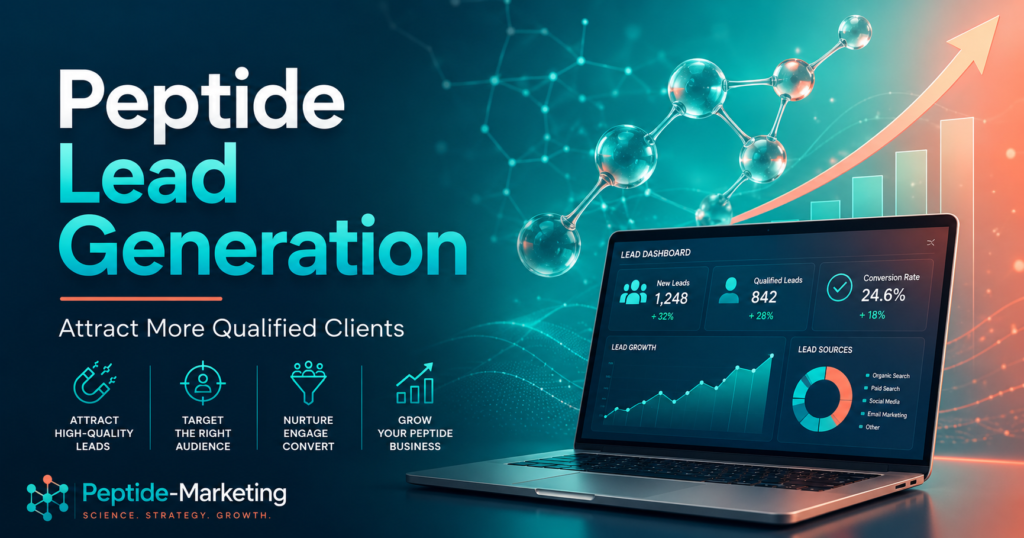
Peptide lead generation is the process of attracting potential customers or business clients and guiding them toward an inquiry, consultation, email signup or purchase.
It is not simply about increasing website traffic, followers or impressions. A successful strategy attracts people who genuinely need what the company provides and gives them a clear reason to take the next step.
For peptide companies, lead generation usually requires several marketing channels working together. Search engine optimization creates visibility. Educational content answers questions. A professional website builds trust. Social media creates awareness. Email continues the relationship. Conversion optimization turns more interest into action.
For a complete introduction to this connected approach, read What Is Peptide Marketing?.
What Is Peptide Lead Generation?
Peptide lead generation focuses on attracting relevant prospects and collecting enough information to continue the business relationship.
Depending on the company, a lead may be:
- A customer joining an email list
- A business requesting a wholesale quote
- A clinic asking about a service
- A laboratory requesting product information
- A peptide company booking a marketing consultation
- A website visitor completing a contact form
- A potential customer beginning checkout
Not every visitor is a qualified lead.
A visitor who has no need for the company’s products or services may increase traffic statistics without creating business value. Qualified leads are people or companies whose needs, budget and interests match what the business provides.
Why More Traffic Does Not Always Mean More Leads
Traffic is useful only when the website attracts the right audience and helps visitors move forward.
Paid traffic can support lead generation, but campaign approval and landing-page quality must be considered first. Read Why Peptide Ads Get Rejected on Meta and Google.
A peptide website may receive thousands of monthly visits but generate few inquiries because:
- The keywords attract the wrong audience
- The company’s offer is unclear
- Product or service pages lack useful information
- Trust signals are missing
- Calls to action are difficult to find
- Forms are too long
- The mobile experience is poor
- Visitors receive no follow-up
This is why lead generation must connect traffic acquisition with website conversion.
Our guide on Why Most Peptide Websites Fail to Convert Visitors explains how unclear positioning, weak trust and poor customer journeys cause potential customers to leave.
Attract Qualified Visitors Through Peptide SEO
Peptide SEO helps companies appear when potential customers search for relevant information, products or services.
The key is targeting searches that match the business.
Broad educational keywords can increase awareness, while commercial keywords are usually more closely connected to leads.
For example:
- “What are peptides?” represents broad educational intent.
- “Peptide marketing agency” represents commercial investigation.
- “Peptide website development” suggests a service need.
- “Peptide SEO services” suggests that someone may be comparing providers.
Each keyword should lead to the page most capable of answering that search.
A general guide should educate. A service page should explain the solution. A case study should provide evidence. A contact or booking page should make the next step easy.
Read Why Peptide SEO Is Different From Traditional SEO for a deeper explanation of specialized keyword research and search intent.
Use Content to Educate and Qualify Leads
Educational content can help potential customers understand their problem before speaking with the company.
Effective content may include:
- Blog articles
- Frequently asked questions
- Product guides
- Comparison pages
- Case studies
- Checklists
- Email resources
- Short educational videos
The purpose is not to publish as many articles as possible.
Each piece should answer a genuine question and connect the reader with a useful next step.
For example, someone reading about website trust could be directed toward website development. A reader learning about organic rankings could be directed toward SEO services. A visitor reading about content planning could be invited to request a strategy review.
Our guide to Peptide Content Marketing explains how educational content can build visibility, credibility and qualified leads.
Build a Website That Converts Attention Into Action
A visitor who reaches your website should quickly understand:
- What the company provides
- Who it serves
- Why it is credible
- What action to take next
Professional Peptide Website Design and Development should support that journey.
Important conversion elements include:
- A clear homepage message
- Detailed product or service pages
- Simple navigation
- Fast mobile performance
- Visible contact information
- Helpful policies
- Relevant quality information
- Short lead forms
- Strong calls to action
Trust is especially important when a visitor is unfamiliar with the company.
Review the 10 Trust Signals Every Peptide Website Needs to identify the credibility elements that may be missing from your website.
Capture Visitors Who Are Not Ready Yet
Most visitors will not purchase or book a consultation during their first visit.
A website should provide a lower-commitment way to continue the relationship.
Possible lead magnets include:
- Peptide website checklist
- SEO audit template
- Content planning guide
- Website trust scorecard
- Product page checklist
- Marketing strategy worksheet
The visitor receives something useful in exchange for an email address.
Email Marketing for Peptide Brands can then nurture that interest through a welcome sequence, educational emails, case studies and relevant service offers.
This allows the company to stay connected without depending on the visitor remembering to return.
Capturing an email address is only the first step. Read our guide to Peptide Email Marketing to learn how automated flows can nurture leads after they leave the website.
Turn Social Media Attention Into Website Visits
Social Media Marketing can introduce a peptide company to new audiences, but followers alone are not leads.
Every social media post should support a clear objective.
That objective may be:
- Reading a blog article
- Downloading a resource
- Visiting a service page
- Joining the email list
- Requesting a review
- Booking a consultation
Educational posts are especially useful because they demonstrate expertise before asking for a sale.
One blog article can be repurposed into an Instagram carousel, Facebook post, short video, LinkedIn post and email newsletter. This creates consistent messaging across several channels.
Improve the Conversion Path
Conversion Rate Optimization improves the percentage of visitors who complete an important action.
Common conversion problems include:
- Too many competing buttons
- Weak page headlines
- Long contact forms
- Missing trust information
- Confusing navigation
- Slow mobile pages
- Calls to action that do not match the content
Each page should have one primary goal.
A blog may invite the reader to download a checklist. A service page may encourage consultation booking. A product page may focus on completing a purchase.
The next step should feel natural rather than forced.
Measure Lead Quality, Not Only Lead Volume
A successful campaign should not be judged only by the number of inquiries it generates.
Track whether those inquiries belong to the right audience.
Useful metrics include:
- Qualified consultation bookings
- Contact form submissions
- Email signups
- Service page visits
- Lead-to-call rate
- Call-to-client rate
- Lead source
- Cost per qualified lead
- Revenue influenced by content
- Conversion rate
Ten qualified leads can be more valuable than one hundred irrelevant inquiries.
The purpose of peptide lead generation is not to create the largest possible audience. It is to build a reliable path between relevant attention and business growth.
Frequently Asked Questions
What is peptide lead generation?
Peptide lead generation is the process of attracting potential customers or clients and guiding them toward an inquiry, email signup, consultation or purchase.
How can a peptide company generate leads?
A peptide company can generate leads through SEO, educational content, professional website design, social media, email marketing, referrals and conversion optimization.
Can Peptide SEO generate qualified leads?
Yes. SEO can generate qualified leads when the website targets commercially relevant keywords and directs visitors toward appropriate product, service or consultation pages.
Why are website trust signals important?
Trust signals reduce uncertainty. Clear company information, contact details, useful content, professional design and transparent policies can make visitors more comfortable taking action.
Is content marketing better than paid advertising?
They serve different purposes. Paid advertising can create faster visibility, while content and SEO can build long-term organic discovery. A diversified strategy is generally more stable than depending on one channel.
Build a Connected Peptide Lead Generation System
Peptide lead generation works best when SEO, content, websites, social media, email and conversion optimization support one another.
How to Market a Peptide Company explains how these channels fit into a complete growth strategy.
Peptide-Marketing helps peptide companies identify where potential leads are being lost and build a clearer path from discovery to conversion.
Is Your Website Generating the Right Leads?
Peptide-Marketing can review your SEO, content, website and conversion path to identify practical opportunities for attracting more qualified prospects.