A peptide website redesign should not begin because a website looks a little old.
It should begin when the existing site is making it harder for people to find the business, understand the offer, trust the company or take the next step.
Sometimes those problems can be fixed through SEO, conversion optimization or better content.
Sometimes the foundation itself has become the problem.
A redesign also needs a migration plan. Before launching the new site, use our Peptide Website Migration SEO checklist to protect existing URLs, rankings, backlinks and organic traffic.
That distinction matters because rebuilding a website without understanding what is already working can create unnecessary cost and even introduce new SEO problems.
Before making that decision, start with a complete Peptide Website Audit. The audit should show whether the biggest problems are isolated issues or signs that the website needs a more fundamental rebuild.
Should You Optimize or Redesign a Peptide Website?
Optimization makes sense when the website structure is basically sound.
You might improve the homepage messaging, rewrite product pages, strengthen internal linking, speed up the site or simplify a form without replacing the entire website.
A redesign becomes more reasonable when several important problems overlap.
For example, if the website is slow, difficult to use on mobile, visually inconsistent, poorly structured for SEO and confusing for visitors, fixing each problem individually may become more expensive and complicated than rebuilding the system properly.
Professional Peptide Website Design and Development should therefore start with diagnosis rather than design trends.
The goal is not simply to make the site look newer.
The goal is to make the business easier to discover, understand, trust and buy from.
1. Visitors Cannot Quickly Understand What You Do
Open your homepage and imagine you know nothing about the company.
Can you understand the business within a few seconds?
A strong homepage should make the core offer obvious.
Visitors should not have to scroll through several sections before working out whether you are a peptide supplier, research company, manufacturer, ecommerce business or industry service provider.
Unclear positioning affects more than design.
It can weaken advertising performance, organic search engagement and conversion because the visitor is forced to work out what the company actually does.
Our guide on Why Most Peptide Websites Fail to Convert Visitors explains why visual appearance alone is not enough to produce results.
If the whole site was built around unclear messaging, a redesign may give you the opportunity to rebuild the customer journey around a stronger value proposition.
2. The Website Feels Difficult on Mobile
A website can look impressive on a large monitor and still be frustrating on a phone.
Common problems include navigation that takes up too much screen space, buttons that are difficult to tap, oversized images, long text sections, awkward product grids and forms that feel exhausting to complete.
Google recommends looking at page experience as a combination of factors rather than focusing on a single score, including mobile display, secure browsing and overall usability.
A mobile problem that appears across only one or two pages can usually be optimized.
If mobile problems are built into the theme, templates and page structure throughout the website, redesigning the site may be the cleaner solution.
3. Your Website Is Consistently Slow
Speed problems are often symptoms of deeper technical decisions.
An old theme, heavy page builder, oversized media library, excessive scripts or years of plugins added on top of one another can make performance improvements increasingly difficult.
Google’s Core Web Vitals focus on real-world loading performance, responsiveness and visual stability.
Speed does not need to become an obsession with achieving a perfect score.
The practical question is whether users can access and interact with the important parts of the website without frustrating delays.
If speed improvements require repeatedly patching a technically bloated system, rebuilding on a cleaner foundation can make more sense.
4. Important Pages Were Never Built Around Search Intent
A website may have dozens of pages but still lack a clear SEO structure.
The homepage may be trying to target every keyword.
Product categories may have almost no useful copy.
Multiple pages may target the same search.
Blog articles may attract traffic but have no relationship with commercial pages.
A good Peptide SEO structure gives different pages different jobs.
Educational articles should answer questions.
Product and collection pages should serve relevant commercial or transactional searches.
Service pages should explain specific solutions.
Case studies should provide evidence.
The site architecture should connect them through logical internal links.
If this structure is missing across the entire website, redesigning the architecture can be more effective than trying to force an SEO strategy onto a structure that was never designed for search.
5. The Website No Longer Reflects the Brand
Businesses change.
The website often does not.
You may have added new products, entered new markets, changed your positioning, expanded the team or developed a more professional brand while the website still represents the company as it existed several years ago.
That inconsistency creates friction.
Visitors may see one brand on social media, another in advertisements and a noticeably older version when they reach the website.
A redesign should bring together your typography, imagery, messaging, page structure and brand identity rather than changing colors simply for the sake of making the site look different.
Consistency becomes particularly important when visitors first discover the brand through Social Media Marketing or paid campaigns and then move to the website.
6. Visitors Have Too Many Reasons to Hesitate
Peptide businesses often require stronger trust communication than ordinary ecommerce sites.
Potential customers may look for company information, contact details, quality documentation, transparent policies, secure checkout, shipping information and other signals before they are comfortable taking action.
If those elements are missing or buried throughout the site, adding a nicer homepage will not solve the real problem.
Read 10 Trust Signals Every Peptide Website Needs and compare them with your current website.
If trust information can be added to existing templates, optimization may be enough.
If the entire customer journey lacks places to communicate credibility properly, the redesign should make trust part of the page structure from the beginning.
7. Your Traffic Is Growing but Leads Are Not
This is one of the clearest signs that the problem may no longer be traffic acquisition alone.
A business can increase search traffic or advertising clicks while the number of inquiries, purchases or bookings barely moves.
At that point, buying even more traffic may only increase the number of people experiencing the same conversion problem.
Your Peptide Landing Page Optimization should first examine individual pages.
Then Conversion Rate Optimization can help identify where visitors hesitate, stop or leave.
If the conversion problem appears across the homepage, navigation, product pages, forms and checkout, the website may need more than individual landing page changes.
A redesign can rebuild those paths around a clearer journey.
Traffic → Relevant Page → Trust → Action → Follow Up
This is also why we recommend comparing Peptide SEO vs Paid Ads before simply increasing marketing spend.
Both channels still depend on the website they send people to.
8. Your Marketing Tools Do Not Work Together
Modern websites rarely operate alone.
They may connect with analytics, advertising pixels, email systems, CRM tools, checkout platforms, forms, booking systems and other services.
Problems appear when those tools were added separately over several years without a clear plan.
You may have duplicate tracking.
Forms may not feed the right system.
Important conversions may not be measured.
Email follow up may not trigger correctly.
Advertising platforms may receive incomplete conversion data.
A proper website rebuild should map these systems before launch.
Your Peptide Marketing Funnel should connect acquisition, website conversion and follow up instead of treating every marketing channel as an isolated activity.
For example, someone arriving from SEO or Meta and Google Ads may not convert immediately.
A properly connected Email Marketing system can continue that relationship after the first website visit.
9. Making Small Changes Has Become Harder Than It Should Be
This problem is often overlooked.
Ask your team what happens when someone wants to publish a new landing page, change a homepage section, add a product category or update a form.
If every change requires workarounds, custom fixes or fear that something else might break, the website has become difficult to operate.
A good redesign should not only create a better visitor experience.
It should make the site easier for the business to manage.
Marketing teams need the ability to create content, test offers, publish landing pages and improve important sections without rebuilding the technical foundation every time.
That flexibility becomes increasingly valuable as Peptide Content Marketing and Peptide Lead Generation expand.
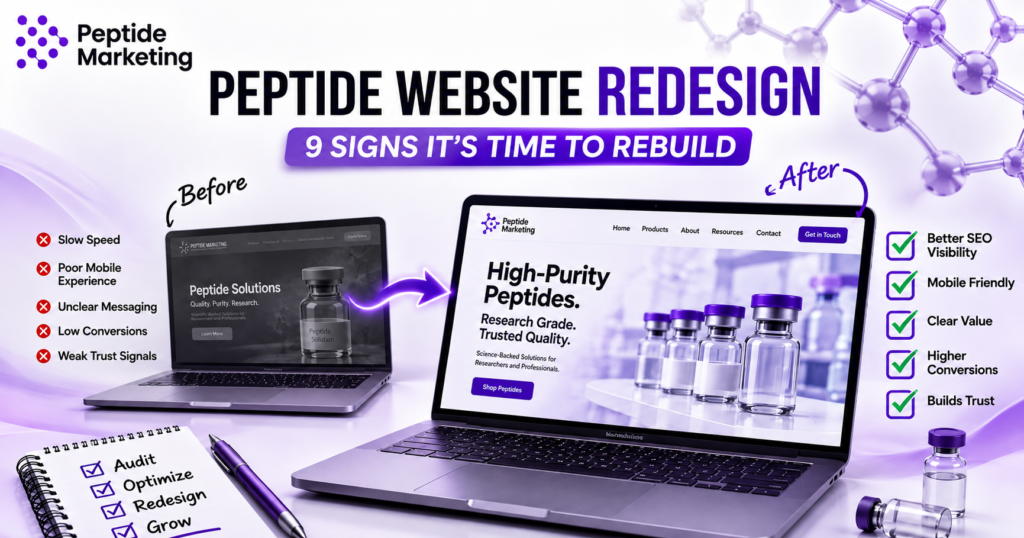
A redesign becomes more compelling when several issues appear in the right-hand column at the same time.
Protect Your SEO During a Website Redesign
One of the biggest redesign mistakes is treating the old website as though nothing on it has value.
Some existing pages may already have rankings, backlinks, traffic or authority.
Do not remove or change URLs unnecessarily.
If URLs must change, map old pages to the most relevant new pages and implement proper permanent redirects.
Google’s current site migration guidance recommends mapping old URLs to their corresponding new URLs, updating internal links, using permanent server-side redirects where appropriate and submitting the updated sitemap.
A redesign should preserve what is already working while improving what is not.
Is Your Current Website Holding Back Growth?
Not sure whether your site needs a few improvements or a complete rebuild?
We can review the current website, identify the biggest issues and tell you which problems are worth fixing first.
Book Your Free 30 Minute Peptide Website Review
Frequently Asked Questions
What is a peptide website redesign?
A peptide website redesign is the process of improving or rebuilding the structure, visual design, content, SEO foundation, user experience and conversion paths of a peptide company website.
How do I know whether to redesign or optimize my peptide website?
Optimize when the underlying website is sound and the problems are limited to specific pages or elements. Consider redesigning when poor performance, outdated architecture, mobile issues, unclear messaging and conversion problems affect the website as a whole.
Can a website redesign hurt SEO?
It can if important pages are removed, URLs are changed without redirects, internal links disappear or technical settings are configured incorrectly. SEO should therefore be included in the redesign process from the beginning.
Should SEO be done before or after a website redesign?
SEO planning should happen before and during the redesign. Keyword mapping, site architecture, URL planning, internal linking and technical requirements should influence how the new site is built.
How often should a peptide website be redesigned?
There is no fixed schedule. A redesign should be based on business needs, website performance and technical limitations rather than redesigning every few years simply because the site is older.
Do Not Redesign Just to Look New
The strongest website redesigns begin with a business problem.
Maybe visitors cannot understand the offer.
Maybe traffic is not converting.
Maybe the website has become painfully slow.
Maybe SEO growth is limited by poor architecture.
Or maybe the company has outgrown the website it launched with.
Whatever the reason, diagnose the problem before rebuilding the solution.
Peptide-Marketing helps peptide businesses connect website development, SEO, conversion optimization, paid acquisition and marketing strategy rather than treating the website as a standalone design project.
You can also review our Peptide Marketing Case Studies to see how website, SEO, paid advertising, email and CRO can work together. The current case study page includes examples where multiple acquisition and conversion channels were used together.