
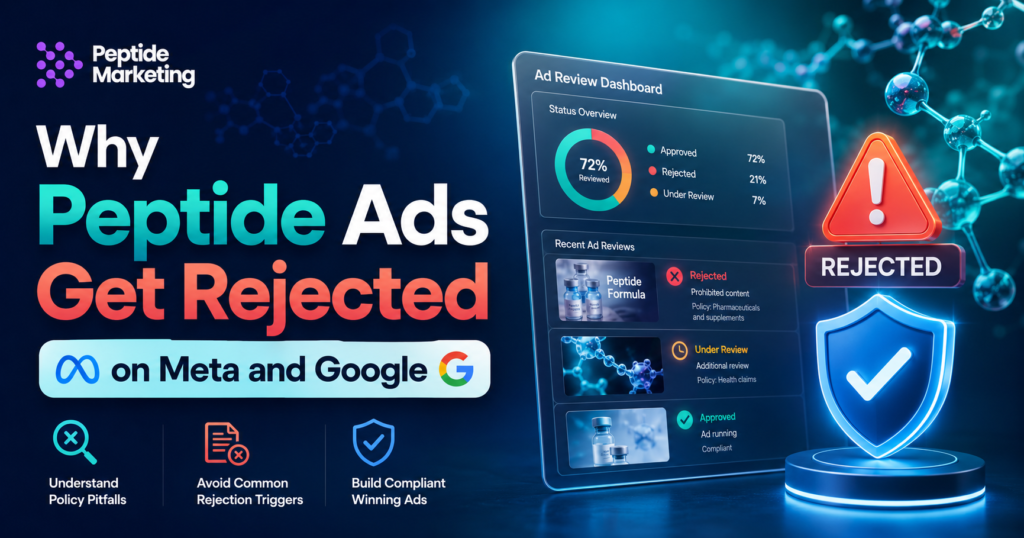
Peptide ads may be rejected when the advertising platform identifies a potential problem with the product, promotional claim, creative, landing page, targeting or website connected to the campaign.
The advertisement itself is only one part of the review. Meta and Google may also evaluate the destination page, business information and wider website experience.
This is why changing one sentence in an advertisement does not always solve the problem. The complete journey from the advertisement to the landing page needs to communicate a clear, accurate and consistent message.
This guide explains the most common areas peptide companies should review before launching paid campaigns.
For a broader overview of how advertising fits into your growth strategy, read What Is Peptide Marketing?.
This article provides general marketing information and is not legal or regulatory advice. Advertising eligibility depends on the product, company, target country and current platform policies.
Paid acquisition should be evaluated alongside organic growth rather than treated as the only source of traffic. Compare Peptide SEO vs Paid Ads to see how the two channels can work together.
What Does a Peptide Ad Rejection Mean?
An ad rejection means the platform has decided that an advertisement, asset or destination does not currently meet one or more advertising requirements.
A rejected advertisement usually cannot run until the advertiser:
- Edits the advertisement or destination
- Removes or corrects the identified issue
- Submits the advertisement for another review
- Appeals the decision when the advertiser believes it was incorrect
Google provides an official process for advertisers to fix a disapproved advertisement or appeal a policy decision. Meta also maintains its current Advertising Standards for advertisements appearing across its platforms.
Approval is never guaranteed, even when a company follows a careful preparation process. Platform policies, automated reviews and local requirements can change.
Why Peptide Advertising Requires Extra Care
Peptide businesses may operate across research, ecommerce, pharmaceutical, wellness or clinical markets. These categories can involve different restrictions depending on the exact product and location.
Meta maintains specific standards covering drugs and pharmaceuticals and health and wellness advertising.
Google also applies location based rules through its Healthcare and Medicines advertising policy. It restricts some healthcare categories, prescription drug services and drug related terminology, while certain advertisers may require certification.
A campaign that is eligible in one location or for one type of business may not be eligible in another.
Before launching, confirm:
- What the business is legally permitted to promote
- Whether certification is required
- Which countries or regions are being targeted
- Whether the product language appears in the advertisement, keywords or landing page
- Whether the company’s website accurately represents the business
1. Promotional Claims Create Review Problems
Strong health, performance or outcome claims can increase advertising risk.
Examples of language that may create problems include claims suggesting:
- Guaranteed results
- Immediate transformation
- Treatment or cure of a condition
- Extreme weight loss
- Benefits that are not adequately supported
- A likely outcome that most customers cannot reasonably expect
Google’s Unreliable Claims policy does not allow inaccurate claims or statements that present improbable outcomes as likely results. Google may also assess health related testimonials according to applicable regulatory standards.
Review advertisements for unnecessary promises.
Instead of making dramatic outcome claims, focus on accurate information about the company, service, process or product category where promotion is permitted.
2. The Advertisement and Landing Page Do Not Match
The message in an advertisement should match what visitors see after clicking it.
Problems can occur when:
- The advertisement promotes one offer but the landing page shows another
- The advertisement sounds educational but leads directly to a highly promotional product page
- The advertised product is difficult to find
- The final URL redirects visitors to an unrelated destination
- Important conditions are hidden
- Pricing or availability differs from the advertisement
Google’s Destination Requirements require landing pages to be functional, useful, accessible and easy to navigate. Google also prohibits misleading representation and promotions that are not relevant to the destination.
Your advertisement, headline, landing-page title and call to action should tell one consistent story.
3. The Website Lacks Trust Signals
An advertising platform review is not based only on visual design. However, an incomplete website can make it harder to establish a clear and credible business identity.
Before launching a campaign, check whether visitors can easily find:
- The official company name
- Contact information
- An About page
- Shipping and return information
- Privacy and terms pages
- Product or service details
- Clear pricing where relevant
- Quality or testing information where applicable
- Appropriate disclaimers
- A working checkout or inquiry process
Read the 10 Trust Signals Every Peptide Website Needs for a complete credibility checklist.
Professional Peptide Website Design and Development can also help ensure the destination is clear, fast and easy to use.
4. Product Positioning Is Unclear
Ambiguous wording may make it difficult for reviewers and customers to understand what is being promoted.
The website should clearly communicate:
- What the product or service is
- Who the intended audience is
- Whether the business serves research, ecommerce, clinical or business audiences
- Which claims the company is qualified to make
- Which actions visitors can complete
- Where the company operates
Avoid mixing research language, consumer benefits and clinical claims on the same landing page without a clear and legitimate structure.
The positioning used in the advertisement should remain consistent across the landing page, product pages, About page and website policies.
5. The Creative Uses Risky Visual Language
Images and videos can affect how an advertisement is interpreted.
Review creatives for:
- Before and after imagery
- Body transformation visuals
- Medical procedures
- Needles or injections
- Sensational warning symbols
- Fake system notifications
- Unclear product labels
- Visuals implying guaranteed results
- Images unrelated to the destination
Google prohibits advertising designs that imitate system notifications or create a misleading interaction.
Use clear, professional creative that accurately represents the approved offer. A biotechnology design can communicate the industry without making unsupported medical or performance promises.
6. The Landing Page Is Difficult to Use
A destination may create problems when it loads slowly, does not work on mobile or prevents visitors from finding important information.
Getting an advertisement approved is only the first step. The destination also needs to turn relevant clicks into business opportunities. Read our complete guide to Peptide Landing Page Optimization
Check for:
- Broken links
- Missing pages
- Intrusive popups
- Slow images
- Nonfunctional forms
- Checkout errors
- Mobile text that is difficult to read
- Pages blocked from crawlers
- Redirects to unexpected domains
- Very little original information
Google states that advertising destinations must work on common browsers and devices, remain accessible in the targeted location and provide a useful experience.
If your website receives clicks but few inquiries, read Why Most Peptide Websites Fail to Convert Visitors.
Conversion Rate Optimization can help improve landing-page clarity, forms, calls to action and the journey after the click.
7. Repeated Resubmission Creates More Problems
Repeatedly submitting the same advertisement without fixing the underlying issue is rarely a strong strategy.
Instead:
- Read the exact policy label
- Review both the advertisement and destination
- Correct the likely issue
- Confirm the website works properly
- Submit the corrected version
- Appeal only when you have a reasonable basis
Google allows advertisers to appeal directly from the account after fixing an issue or when they believe the original decision was incorrect.
Keep a record of rejected copy, revised copy, landing pages and review outcomes. This can help your team avoid repeating the same problems.
Peptide Advertising Prelaunch Checklist
Before publishing a campaign, review the following:
Advertisement
- Is the wording accurate?
- Are the claims supportable?
- Is the offer clear?
- Does the creative avoid sensational imagery?
- Does the call to action match the destination?
Landing page
- Does the headline match the advertisement?
- Is the advertised offer easy to find?
- Does the page work on mobile?
- Are the business and contact details visible?
- Are important policies accessible?
- Does the page contain useful original information?
Business setup
- Is the company name consistent?
- Is the target location appropriate?
- Is any required certification in place?
- Is conversion tracking working?
- Is there a process for reviewing comments, leads and follow-up?
For professional campaign support, explore Meta and Google Ads for Peptide Brands.
Paid Advertising Should Not Work Alone
Even approved advertising can become expensive or unstable when it is the company’s only source of growth.
A more balanced system may combine:
- Peptide SEO for organic discovery
- Peptide Content Marketing for education and authority
- Peptide Lead Generation for capturing relevant prospects
- Peptide Email Marketing for follow-up and retention
- Website conversion improvements for turning traffic into action
This connected approach reduces dependence on one advertising account and creates more ways for potential customers to discover and return to the business.
Frequently Asked Questions
Why are my peptide ads being rejected?
A peptide advertisement may be rejected because of the product category, claims, creative, landing page, website information, target location or another platform policy. Review the specific policy label before editing the campaign.
Can peptide companies advertise on Meta and Google?
Eligibility depends on the product, business model, location and current platform rules. Some healthcare or pharmaceutical advertisers may face restrictions or certification requirements.
Does changing the advertising copy fix a rejection?
Not always. The platform may also review the landing page and wider website. Copy changes will not fix issues related to the product, destination, business identity or certification.
Should I appeal a rejected advertisement?
An appeal may be appropriate when you have corrected the identified issue or believe the original decision was incorrect. Review the policy carefully before submitting it.
Can an approved advertisement be rejected later?
Yes. Platforms may review advertisements again after edits, policy updates, user reports or other account activity. Approval should not be treated as permanent.
Reduce Avoidable Peptide Advertising Problems
Successful peptide advertising begins before the campaign is published.
The advertisement, creative, landing page, website policies, business information and follow-up process should all support the same clear and accurate message.
Peptide-Marketing helps peptide businesses review paid advertising campaigns within a broader system that includes websites, SEO, content, email and conversion optimization.
Preparing to Launch a Peptide Campaign?
Peptide-Marketing can review your advertisement, creative, landing page and website journey to identify avoidable concerns before you begin spending.