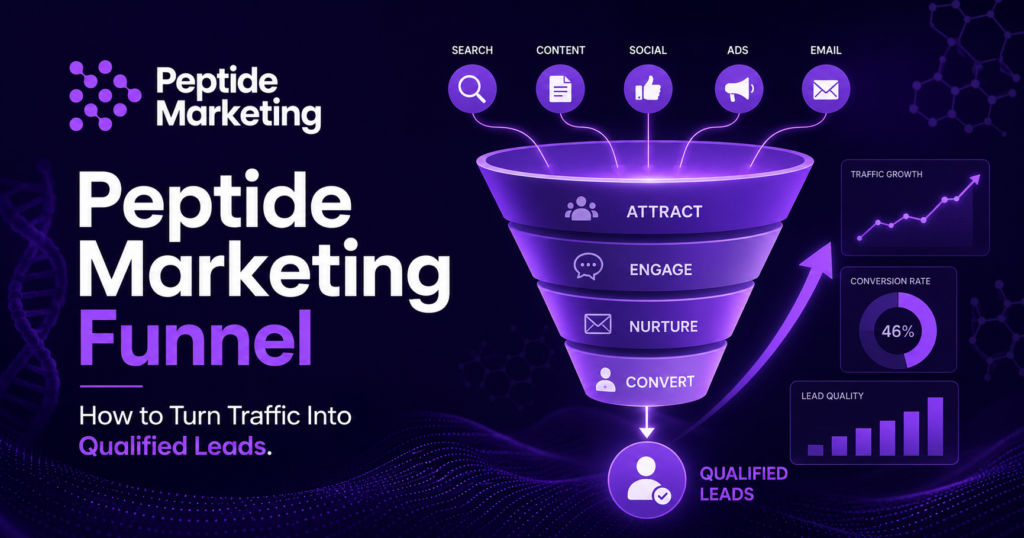
A peptide marketing funnel is the path that moves a potential customer from discovering a peptide company to taking a meaningful action such as making a purchase, requesting information, joining an email list or booking a consultation.
A funnel can only perform as well as the website supporting it. Use our Peptide Website Audit to identify technical, trust and conversion gaps.
The strongest funnels connect SEO, content, paid advertising, social media, website experience, email follow up and conversion optimization so each stage supports the next.
If you are new to the topic, start with What Is Peptide Marketing? and use this guide to connect your marketing channels into one customer journey.
What Is a Peptide Marketing Funnel?
A peptide marketing funnel usually includes six stages:
- Awareness: a potential customer discovers the brand.
- Education: the visitor learns about the company, product or service.
- Trust: the website reduces uncertainty.
- Conversion: the visitor takes the intended action.
- Follow up: the company continues the relationship.
- Retention: customers return or engage again.
Each stage should match the visitor’s search intent and readiness to act.
For a broader framework, read How to Market a Peptide Company.
1. Start With Qualified Awareness
The first stage is getting discovered by the right audience.
Peptide SEO can help a company become visible for relevant educational and commercial searches.
Our guide on Why Peptide SEO Is Different From Traditional SEO explains why search intent, technical terminology, trust and content structure require a specialized approach.
Awareness can also come from Social Media Marketing, referrals and Meta and Google Ads.
The goal is relevant traffic, not traffic for its own sake.
2. Use Content to Educate the Visitor
Once someone discovers the company, the website must help them understand what they found.
Peptide Content Marketing can support this stage through blogs, product guides, FAQs, comparisons, case studies and checklists.
A website trust article, for example, can naturally lead to Peptide Website Design and Development, while an SEO article can lead to the SEO service.
This is why internal linking should support the customer journey instead of existing only for SEO.
Helpful content gives visitors another reason to remain on the website, explore related topics and learn more about the business before making a decision.
3. Build Trust Before Asking for Action
A visitor may understand the offer and still hesitate.
Useful trust signals include clear company information, visible contact details, professional branding, helpful policies, secure website functionality, detailed service information, authentic reviews and relevant proof.
Our guide to 10 Trust Signals Every Peptide Website Needs provides a practical checklist.
You can also direct visitors to your Peptide Marketing Case Studies when real examples help them evaluate your capabilities.
Trust should be visible before the visitor reaches an important purchase, inquiry or booking decision.
4. Turn Interest Into a Clear Conversion Path
Once visitors understand and trust the company, the next action should be obvious.
Our article on Why Most Peptide Websites Fail to Convert Visitors explains how unclear messaging, weak calls to action, poor mobile usability and confusing customer journeys can stop interested visitors from moving forward.
A strong conversion page should have one main goal, a clear headline, relevant trust signals, a visible call to action and a practical form.
Peptide Landing Page Optimization becomes especially important when visitors arrive from advertising. The page should continue the same message that encouraged the click.
Conversion Rate Optimization can help identify where visitors hesitate and which improvements may strengthen the path from traffic to action.
5. Capture Leads Who Are Not Ready Yet
Not every qualified visitor will purchase or book a call during the first visit.
A good funnel offers a lower commitment next step such as joining an email list, downloading a checklist, requesting an audit or starting an inquiry.
This connects website traffic with Peptide Lead Generation.
The offer should match the visitor’s current interest and provide a useful next step without forcing a decision too early.
For example, someone researching SEO may prefer an SEO checklist, while a company reviewing its website may be more interested in a conversion or trust audit.
This gives Peptide-Marketing another opportunity to continue the conversation after the original website visit.
6. Use Email to Continue the Relationship
Once someone chooses to stay connected, email can move the relationship forward.
Peptide Email Marketing can include welcome flows, educational sequences, inquiry follow up, abandoned checkout communication and reengagement campaigns.
This is why Email Marketing for Peptide Brands should be connected to the website and content strategy.
A person who first discovers a company through Google may read an article, join the email list and return later after receiving useful information.
The funnel therefore continues even after the original website session ends.
7. Make Paid Advertising Part of the Funnel
Paid advertising can accelerate visibility, but it should not become the entire growth system.
Peptide companies can face additional advertising review challenges, so review Why Peptide Ads Get Rejected on Meta and Google before launching campaigns.
Paid ads work best when they send relevant visitors into a website with strong messaging, trust and conversion paths. A diversified funnel also reduces dependence on one traffic source.
SEO can support long term discovery, content can answer questions, social media can maintain awareness and email can reconnect with people who are not ready to act immediately.
The channels become stronger when they support one another.
8. Measure the Funnel by Business Outcomes
A funnel should be measured by business outcomes rather than followers, impressions or page views alone.
Useful metrics include:
- Organic impressions and clicks
- Landing page conversion rate
- Qualified form submissions
- Email signups
- Consultation bookings
- Cost per qualified lead
- Lead to client conversion rate
- Repeat purchase rate
A smaller number of relevant visitors can create more value than a much larger audience that never takes action.
At Peptide-Marketing, the goal is to connect acquisition, education, trust, conversion and retention rather than treating each marketing channel as an isolated activity.
A strong reporting system should help you understand not only where visitors came from, but what they did after arriving.
Frequently Asked Questions
What is a peptide marketing funnel?
A peptide marketing funnel is the connected customer journey that moves people from awareness and education through trust, conversion, follow up and retention.
What channels should a peptide marketing funnel include?
A complete funnel can include SEO, content, social media, paid advertising, website development, landing pages, email marketing and conversion optimization.
Does every peptide company need paid advertising?
No. Paid advertising can accelerate visibility, but companies can also generate opportunities through SEO, content, referrals, social media, email and direct traffic.
Why is internal linking important?
Internal links help visitors move from educational content to related guides, services and conversion pages. They also create clearer relationships between the topics across the website.
How do you improve a peptide marketing funnel?
Start by identifying where qualified visitors stop moving forward. Review traffic quality, content relevance, website trust, landing pages, forms, calls to action and follow up.
Build a Connected Peptide Marketing Funnel
The strongest peptide marketing strategy does not ask one channel to do everything.
SEO creates discovery. Content provides education. Social media expands distribution. Paid advertising creates targeted traffic. The website builds trust. Landing pages guide action. Email continues the relationship. CRO improves the journey.
Peptide-Marketing helps peptide companies connect these channels into one practical growth system rather than a collection of disconnected campaigns.
If your website is receiving attention but your marketing channels are not producing enough qualified opportunities, we can review the complete journey from traffic source to conversion.