
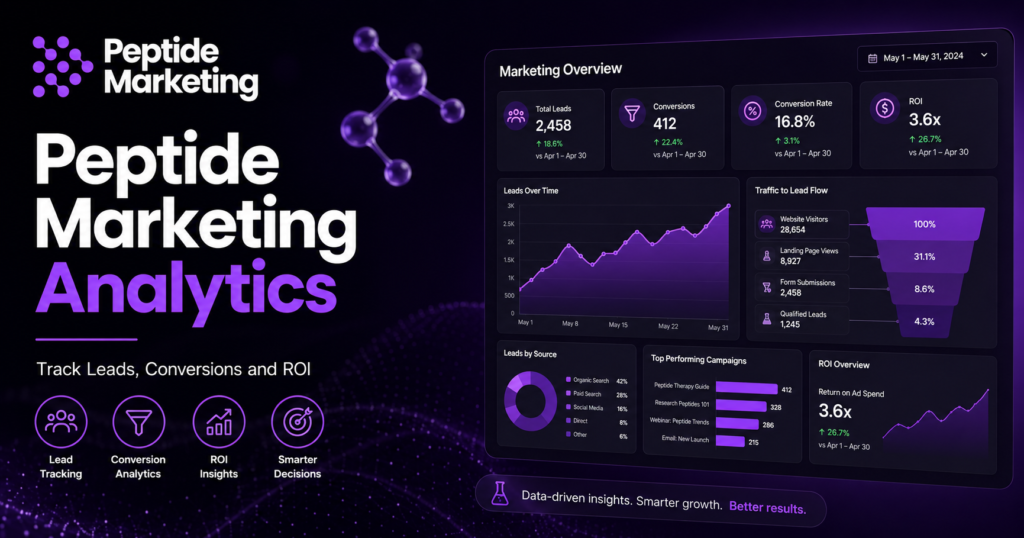
Peptide marketing analytics is the process of measuring how people discover a peptide company, what they do after arriving, which marketing channels generate qualified leads and which activities ultimately contribute to customers and revenue.
The goal is not to collect the largest possible number of reports.
The goal is to answer a much more useful question:
Which parts of our peptide marketing strategy are actually producing business opportunities?
A practical measurement system should connect:
Traffic → Lead → Qualified Lead → Conversation → Customer
If you have already built a Peptide Marketing Funnel, analytics tells you where that funnel is working and where potential customers are disappearing.
Why Traffic Alone Is Not Enough
Website traffic is useful, but it is not a complete measure of marketing performance.
Imagine two marketing channels.
One generates 5,000 visitors and only a handful of relevant inquiries.
Another generates 600 visitors and 25 qualified conversations with potential customers.
Looking only at traffic would make the first channel appear more successful. Looking at business outcomes may tell a completely different story.
That is why Peptide Lead Generation should focus on attracting the right audience rather than simply increasing visitor numbers.
For every major traffic source, ask:
- How many visitors arrived?
- How many became leads?
- How many leads were actually relevant?
- How many booked a call or started a meaningful conversation?
- How many eventually became customers?
Those questions give marketing data commercial context.
The Five Metrics Peptide Companies Should Track First
You do not need a complicated dashboard to begin.
Start with five core numbers.
1. Website Visitors
Track how many people are reaching the website and where they came from.
Important sources may include:
- Organic search
- Paid advertising
- Social media
- Referrals
- Direct traffic
Traffic tells you whether your marketing is creating attention.
It does not tell you whether that attention is valuable.
2. Leads
A lead is someone who takes an action that allows the business relationship to continue.
Depending on the company, that might include:
- Completing a contact form
- Requesting a quote
- Joining an email list
- Starting a wholesale inquiry
- Booking a consultation
- Beginning checkout
Google Analytics allows businesses to mark important website actions as key events so they can be measured in reporting.
3. Qualified Leads
This is where your measurement becomes much more useful.
Not every lead is a good lead.
A qualified lead is a person or company whose needs reasonably match what your business provides.
For Peptide-Marketing, for example, a relevant lead could be a peptide company seeking SEO, website development, paid advertising, content or another growth service.
Tracking qualified leads prevents your reporting from rewarding channels that generate large numbers of irrelevant inquiries.
4. Conversations
A conversation is the point where a lead moves beyond a form submission and enters a genuine sales discussion.
That might mean:
- A discovery call
- A sales meeting
- An email exchange
- A WhatsApp conversation
- A wholesale discussion
This metric tells you whether your leads are strong enough to progress.
5. Customers
The final question is simple:
Which marketing activity generated customers?
That connection is what turns marketing analytics from reporting into business intelligence.
Measure SEO by More Than Rankings
Rankings are useful, but rankings without relevant traffic or leads do not necessarily create business value.
Your Peptide SEO reporting should connect search visibility with what happens after the click.
Track:
- Organic impressions
- Organic clicks
- Commercial keyword rankings
- Landing pages receiving search traffic
- Organic leads
- Qualified organic leads
- Calls or sales influenced by organic search
Your guide on Why Peptide SEO Is Different From Traditional SEO already explains why search intent matters.
Analytics completes that strategy by showing whether the keywords you targeted are bringing the audience you actually want.
Measure Content by the Next Action
A blog post should not be judged only by how many page views it receives.
Peptide Content Marketing should help visitors learn, explore and move deeper into the website.
For each article, monitor:
- Organic traffic
- Time and engagement
- Internal link clicks
- Service page visits
- Email signups
- CTA clicks
- Leads generated
For example, someone reading 10 Trust Signals Every Peptide Website Needs might naturally continue to your Peptide Website Design and Development service.
That journey is often more valuable than the article view itself.
Measure Paid Ads Beyond Click Through Rate
A paid advertising campaign can look successful inside an advertising dashboard while producing weak business results.
Clicks and impressions are only the beginning.
For Meta and Google Ads, track:
- Ad spend
- Clicks
- Landing page visitors
- Leads
- Qualified leads
- Cost per qualified lead
- Purchases or calls
- Revenue where measurable
Google Ads provides website conversion measurement for actions users take after interacting with an advertisement, while Google Analytics key events can also be used as the basis for Google Ads conversions.
If campaigns generate clicks but not enough inquiries, review Peptide Landing Page Optimization.
If campaigns struggle before they even generate traffic, review Why Peptide Ads Get Rejected on Meta and Google.
Measure Landing Pages by Conversion Quality
A landing page has a specific job.
It should move the right visitor toward a clear next step.
Useful landing page metrics include:
- Visitors
- CTA clicks
- Form starts
- Form completions
- Conversion rate
- Qualified leads
- Mobile performance
- Lead source
A high conversion rate is not necessarily valuable when the resulting leads are poor.
This is why Conversion Rate Optimization should focus on meaningful business outcomes, not only increasing the percentage shown in a dashboard.
If visitors consistently leave without taking action, your article on Why Most Peptide Websites Fail to Convert Visitors can help identify possible causes.
Measure Email Beyond Open Rates
Email becomes easier to evaluate when you connect the message with what happens afterward.
Your Peptide Email Marketing reporting should include:
- Clicks
- Replies
- Website visits
- Consultation bookings
- Purchases
- Repeat purchases
- Leads generated
- Unsubscribes
The purpose of Email Marketing for Peptide Brands is not simply to produce impressive open rates.
It should help move interested people toward the next stage of the customer journey.
Track Social Media as a Distribution Channel
Follower growth can be useful, but followers do not automatically become customers.
Social Media Marketing should also be evaluated by what people do after seeing the content.
Track:
- Profile visits
- Website clicks
- Blog visits
- Lead magnet downloads
- Direct inquiries
- Consultation bookings
- Assisted conversions
A social post that receives fewer likes but sends several qualified prospects to the website may be more valuable than a viral post that generates no commercial action.
Build a Simple Channel to Lead Scorecard
Create a basic monthly table:
| Channel | Visitors | Leads | Qualified Leads | Conversations | Customers |
|---|---|---|---|---|---|
| Organic Search | |||||
| Paid Ads | |||||
| Social Media | |||||
| Referral | |||||
| Direct |
Do not worry if some cells are currently blank.
Those blanks are useful.
They show you exactly where your tracking system needs improvement.
How Analytics Helps Find Broken Funnel Stages
Marketing analytics becomes most valuable when you use it to diagnose problems.
For example:
High traffic + low leads
The website, offer or call to action may need improvement.
Many leads + few qualified leads
The traffic source or targeting may be wrong.
Qualified leads + few conversations
The follow up process may be weak.
Many conversations + few customers
The offer, pricing or sales process may need attention.
This is the same connected approach described in How to Market a Peptide Company.
The numbers should help you decide what to improve next rather than simply tell you what happened last month.
Frequently Asked Questions
What is peptide marketing analytics?
Peptide marketing analytics is the measurement of traffic, leads, qualified opportunities, conversions and customer outcomes across a peptide company’s marketing channels.
Which marketing metrics should peptide companies track?
Start with website visitors, leads, qualified leads, conversations and customers. Then break those numbers down by traffic source.
How do you measure peptide marketing ROI?
Connect the cost of a marketing activity with the qualified leads, sales or revenue it contributes to. Avoid evaluating ROI using traffic or impressions alone.
What is a qualified lead?
A qualified lead is a prospect whose needs and profile reasonably match the company’s products, services and target audience.
How can I tell which marketing channel works best?
Compare channels using qualified leads, customer acquisition and revenue outcomes rather than traffic alone.
Measure What Actually Grows the Business
The purpose of peptide marketing analytics is not to create a bigger dashboard.
It is to make better decisions.
Peptide-Marketing connects SEO, websites, content, paid advertising, social media, email and conversion optimization around the same objective: turning relevant attention into measurable business opportunities.
If your reporting currently stops at traffic, clicks or followers, the next step is connecting those numbers to qualified leads and customers.
Need a Clearer View of Your Marketing Performance?
Peptide-Marketing can review your traffic sources, website analytics, conversion tracking and lead journey to identify where measurement gaps may be hiding growth opportunities.