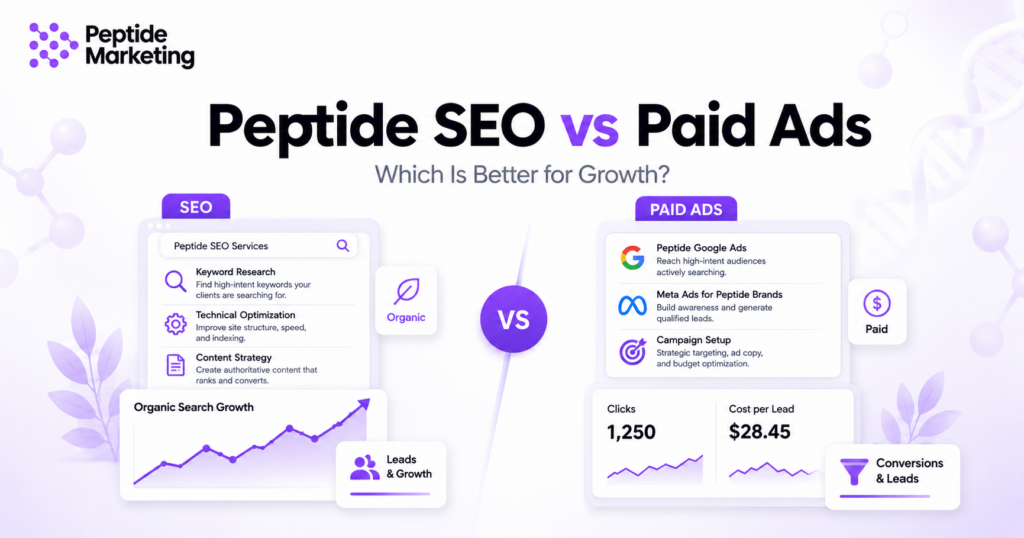
Peptide SEO vs paid ads is not really a question of choosing one channel forever. The better question is which channel should do which job inside your peptide marketing strategy.
SEO helps a peptide company build organic search visibility for relevant educational and commercial searches. Paid advertising can place an offer in front of targeted audiences while the campaign is active and eligible to run.
For many peptide businesses, the strongest approach is not SEO or paid advertising.
It is knowing when to use SEO, when to use paid traffic and how to make both channels support the same customer journey.
For the wider strategy behind these channels, start with What Is Peptide Marketing?.
What Is the Difference Between Peptide SEO and Paid Ads?
Peptide SEO focuses on improving a website so relevant pages can appear in organic search results.
That may involve:
- Keyword research
- Technical SEO
- Product and service page optimization
- Educational content
- Internal linking
- Website speed
- Authority building
- Conversion tracking
Paid advertising uses platforms such as Google or Meta to generate visibility through advertising campaigns.
Your Meta and Google Ads service focuses on paid acquisition rather than organic rankings.
The fundamental difference is how visibility is obtained.
SEO requires investment in content, technical improvements and authority, but businesses do not pay Google for placement in organic search results. Google states that payment for advertising does not influence organic rankings.
Paid advertising requires campaign budget and ongoing management. Google Ads, for example, allows advertisers to set campaign budgets and use bidding systems to compete for eligible ad placements.
Peptide SEO Builds Search Visibility Over Time
SEO is useful when potential customers are already searching for the information, products or services connected to your business.
A peptide company may want visibility for searches such as:
- Peptide marketing agency
- Peptide SEO services
- Peptide website development
- Peptide content marketing
- Research peptide information
- Relevant product categories
- Questions customers ask before purchasing
The advantage of SEO is that one useful page can continue attracting relevant visitors after it has been published.
However, SEO should not be treated as an instant traffic switch.
A company needs useful pages, clear search intent, technical foundations and consistent content development.
Read Why Peptide SEO Is Different From Traditional SEO for a deeper explanation of how search intent, customer education and trust affect peptide search strategy.
Paid Ads Can Create Faster Visibility
Paid advertising can be useful when a company wants to put a specific offer in front of an audience without waiting for organic rankings to develop.
Possible objectives include:
- Product sales
- Lead generation
- Consultation bookings
- New customer acquisition
- Retargeting
- Testing a new offer
- Promoting a landing page
This can make paid media valuable during launches or when a company wants faster feedback on an offer.
But the traffic is connected to an active advertising budget.
When campaigns stop, paid traffic generally stops with them.
Paid campaigns also require the advertisement, targeting, landing page and tracking to work together. Google’s advertising system considers factors such as bid, relevance, ad quality and landing-page experience when determining ad eligibility and position.
For peptide businesses, there is another consideration: advertising eligibility.
Read Why Peptide Ads Get Rejected on Meta and Google before treating paid advertising as your only acquisition channel.
Which Channel Produces Better Leads?
Neither SEO nor paid ads automatically produces better leads.
Search intent and targeting determine lead quality.
A visitor searching for “peptide SEO agency” may already understand the problem and be actively evaluating providers.
That can make a commercially focused SEO visitor highly relevant.
Paid advertising can also generate qualified leads when targeting, creative, offer and landing page all match the right audience.
The important metric is not traffic volume.
It is what happens afterward.
Your Peptide Lead Generation guide explains why businesses should track qualified opportunities rather than visitors alone.
A useful comparison is:
Traffic → Lead → Qualified Lead → Conversation → Customer
Whichever channel consistently moves more of the right people through that path deserves greater investment.
SEO Is Strong for Educational Demand
One major advantage of SEO is the ability to answer questions before someone is ready to buy.
Educational content can target searches from people trying to understand:
- A peptide related topic
- A marketing problem
- Website requirements
- SEO opportunities
- Product terminology
- Industry questions
That is where Peptide Content Marketing becomes important.
Content can attract early stage searches and then guide relevant visitors toward commercial pages.
For example, someone who discovers an educational SEO article can later visit your SEO service page.
Someone researching website credibility can move from the 10 Trust Signals Every Peptide Website Needs article to your Peptide Website Design and Development service.
SEO therefore helps build an information journey before the sales conversation begins.
Paid Ads Are Strong for Testing Offers
Paid advertising can provide a useful testing environment.
Suppose a peptide business wants to compare two offers:
Offer A: Free website audit
Offer B: Free strategy consultation
Paid campaigns can send targeted visitors to each offer and measure which one generates stronger qualified leads.
The company can then use those insights across:
- Landing pages
- Website copy
- Email campaigns
- Organic content
- Calls to action
However, the landing page needs to be ready before increasing spend.
Our Peptide Landing Page Optimization guide explains how message clarity, trust, mobile performance and calls to action affect the journey after the click.
Sending more paid traffic to a weak landing page usually amplifies the weakness rather than solving it.
What About Cost?
The cost structures are different.
With SEO, companies invest in work such as:
- Research
- Content
- Technical optimization
- Website improvements
- Authority development
- Reporting
The traffic itself does not carry a direct cost per organic click.
With paid advertising, there is both management work and media spend.
For CPC campaigns, advertisers may pay when someone clicks an advertisement, depending on the bidding strategy being used.
That does not automatically make SEO cheaper or paid advertising more expensive.
The correct comparison is:
What does it cost to generate a qualified customer?
A $20 click that becomes a valuable client may be excellent.
Thousands of organic visitors who never convert may produce little commercial value.
Always compare acquisition channels using business outcomes.
Your Website Determines the Value of Both
SEO and paid ads eventually send people somewhere.
Usually that destination is your website.
If visitors arrive and find unclear messaging, weak product information, missing trust signals or poor mobile usability, neither channel will perform as well as it could.
This is why Why Most Peptide Websites Fail to Convert Visitors should be part of the SEO versus paid ads conversation.
Traffic acquisition and conversion cannot be separated completely.
Conversion Rate Optimization helps improve what happens once the visitor arrives.
Before spending more on traffic, ask whether the website clearly communicates:
- What you offer
- Who it is for
- Why visitors should trust you
- What they should do next
When Should a Peptide Company Choose SEO First?
SEO may deserve priority when:
- Potential customers actively search for what you offer
- Your website has little organic visibility
- You want to build long term search assets
- You have useful expertise that can become content
- Advertising access is limited
- You want to reduce dependence on paid platforms
SEO is especially valuable when important commercial searches already exist but your competitors currently dominate them.
When Should Paid Ads Come First?
Paid advertising may deserve priority when:
- You need to test demand quickly
- You have a proven offer
- Your landing page already converts
- Conversion tracking is working
- You understand the economics of customer acquisition
- The product or service is eligible for the platform being used
- You have budget available for testing
Paid traffic is easier to evaluate when the rest of the funnel is already measurable.
Your Peptide Marketing Funnel explains how acquisition channels should connect with trust, nurturing and conversion.
The Strongest Strategy Uses Both
SEO and paid ads can support one another.
Paid campaigns can provide early data about:
- Offers
- Landing pages
- Audience response
- Commercial messaging
- Conversion behavior
SEO can build durable visibility around:
- Educational questions
- Commercial searches
- Service categories
- Industry topics
- Branded demand
Email can then continue the relationship with visitors who are not ready to act immediately.
That is where Peptide Email Marketing becomes part of the acquisition system.
Social content can support distribution through Social Media Marketing.
Instead of treating channels separately, use each one for the stage where it is strongest.
How Peptide-Marketing Uses SEO and Paid Ads Together
A practical growth strategy may look like this:
SEO captures existing search demand.
Content educates visitors.
Paid advertising tests and scales targeted offers.
Landing pages convert attention.
Email follows up with people who are not ready yet.
CRO improves the percentage of traffic that becomes customers.
You can see examples of channel combinations in our Peptide Marketing Case Studies, where paid acquisition, SEO, email, website improvements and CRO are used in different combinations depending on the business problem.
That is a more useful approach than deciding that every peptide company should use exactly the same channel mix.
Frequently Asked Questions
Is peptide SEO better than paid ads?
Neither is universally better. SEO is strong for long term organic discovery, while paid advertising can provide faster targeted visibility. The best choice depends on the business, offer, budget, search demand and advertising eligibility.
How long does peptide SEO take?
SEO should be treated as a long term strategy. Results depend on competition, website quality, content, authority, technical performance and target keywords.
Can peptide companies run paid ads?
Advertising eligibility depends on the product, business model, market and current platform policies. Companies should review the rules applying to their specific campaigns before launching.
Should a new peptide company start with SEO or ads?
A new company should first make sure its website, offer, tracking and conversion path are ready. From there, SEO can build organic demand while eligible paid campaigns can test acquisition more quickly.
Can SEO and paid ads run together?
Yes. They often work best together because they solve different acquisition problems. Paid ads can test and scale offers while SEO builds organic visibility across important searches.
Choose the Channel Based on the Business Goal
Before increasing investment in either acquisition channel, make sure the destination is ready for more traffic. Use our Peptide
Website Audit to review SEO, trust, performance and conversion issues first.
The SEO versus paid advertising decision should not be based on which channel sounds more exciting.
Start with the objective.
If the goal is building organic visibility for searches customers already make, invest in SEO.
If the goal is testing an eligible offer quickly with targeted traffic, paid advertising may be appropriate.
If the goal is sustainable growth, the strongest answer is often a combination.
Peptide-Marketing helps peptide companies connect SEO, paid acquisition, websites, content, email and conversion optimization around qualified leads rather than isolated marketing metrics.
Not Sure Whether to Invest in SEO or Paid Ads?
Peptide-Marketing can review your current website, search visibility, advertising readiness and conversion path to identify which channel should receive priority.