
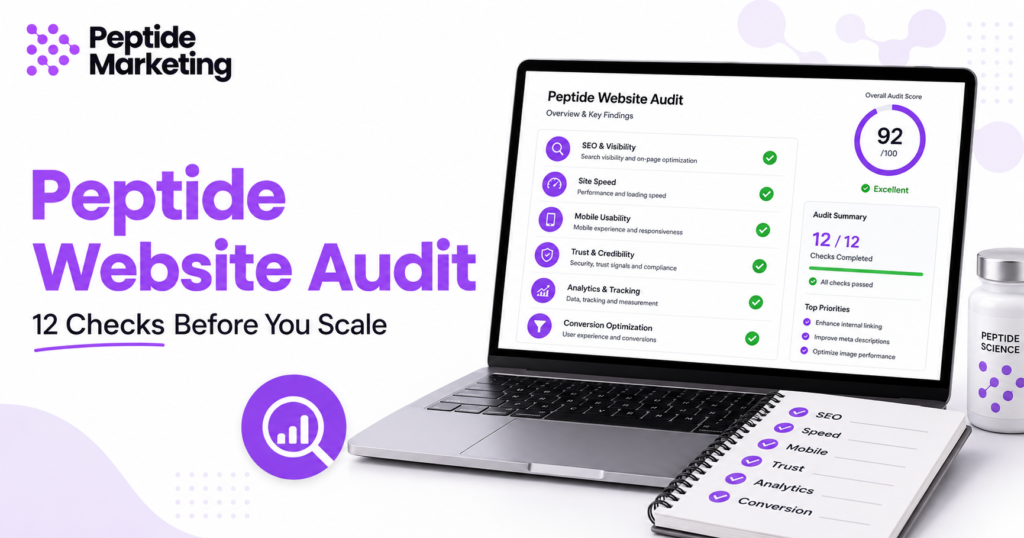
A peptide website audit is a structured review of your website’s SEO, content, usability, trust, performance and conversion paths.
Before increasing your SEO budget or putting more money into paid advertising, it makes sense to check whether the website receiving that traffic is actually ready for it.
More traffic cannot fix unclear messaging, slow pages, weak product information or a confusing customer journey.
A practical peptide website audit should answer one question:
What is stopping the right visitor from finding, trusting or converting on this website?
For a broader look at how traffic channels fit together, read our comparison of Peptide SEO vs Paid Ads.
1. Check Your Homepage Positioning
Start with the first screen a visitor sees.
Within a few seconds, someone should understand:
- What your company provides
- Who it serves
- Why the offer is relevant
- What they should do next
Avoid generic headlines that could belong to almost any business.
Your homepage should clearly communicate the business and guide visitors toward products, services, information or a consultation.
If the positioning is unclear, adding more traffic will simply expose the same problem to more people.
Professional Peptide Website Design and Development should combine visual design with clear messaging and conversion structure.
2. Review the Mobile Experience
Do not assume that a website working on desktop works equally well on mobile.
Check the site on an actual phone.
Look at:
- Headline sizes
- Navigation
- Buttons
- Product cards
- Forms
- Popups
- Images
- Tables
- Checkout
- Contact options
Important buttons should be easy to tap and text should not require zooming.
Oversized images, complicated menus and long forms can create unnecessary friction.
If mobile visitors have to fight the interface before understanding the offer, marketing performance will suffer regardless of how good the campaign is.
3. Test Website Speed and Performance
A slow site creates friction before the visitor even reads your message.
Review:
- Large image files
- Unnecessary plugins
- Video backgrounds
- Excessive animations
- Third party scripts
- Caching
- Hosting performance
- Font loading
Do not optimize speed only for a score.
The goal is a website that feels fast and stable to real visitors.
This is especially important for landing pages receiving advertising traffic because every extra delay adds another opportunity for someone to leave.
Your Peptide Landing Page Optimization should therefore include performance as well as copy and design.
4. Audit Technical SEO
Next, check whether search engines can properly access and understand the site.
Review:
- Indexing settings
- XML sitemap
- Robots directives
- Canonical URLs
- Broken links
- Redirects
- Page titles
- Meta descriptions
- Heading structure
- Image alt text
- Internal links
- Structured data
A technically weak website can limit the value of otherwise strong content.
Your Peptide SEO strategy should make sure important pages are crawlable, clearly structured and aligned with relevant search intent.
Technical SEO creates the foundation. Content and authority then build on top of it.
5. Review Keyword Targeting and Search Intent
Every important page should have a clear search purpose.
Do not try to make the homepage rank for every keyword connected to the business.
For example:
An educational article can target an informational search.
A service page can target a commercial search.
A product page can target product specific intent.
A landing page can focus on one campaign or offer.
This separation helps both visitors and search engines understand what each page is designed to accomplish.
Your website should connect broad informational traffic with commercially relevant pages instead of expecting every search visitor to convert immediately.
6. Audit Product and Service Page Quality
Thin pages are a common weakness.
A useful product page may need:
- A clear product name
- Unique description
- Relevant specifications
- Quality information
- Supporting documentation
- Shipping details
- Frequently asked questions
- Related products
- A clear purchase action
A service page should explain:
- What the service includes
- Who it is for
- Which problem it solves
- How the process works
- Why the company is qualified
- What happens next
The goal is to answer the questions that might otherwise make a visitor leave and continue researching elsewhere.
Free 12 Point Peptide Website Audit
Planning to invest more in SEO, content or paid advertising?
Peptide-Marketing can review your website across SEO, trust, speed, mobile usability, messaging and conversion paths before you increase your marketing spend.
Book Your Free Peptide Website Audit
7. Check Website Trust Signals
Visitors need reasons to feel confident before taking action.
Review whether the website includes relevant trust elements such as:
- Clear company information
- Visible contact details
- Professional branding
- Transparent policies
- Secure website functionality
- Authentic testimonials
- Case studies
- Quality information where applicable
- Helpful FAQs
- Consistent company details
Trust should appear throughout the customer journey rather than being hidden on one page.
Use our 10 Trust Signals Every Peptide Website Needs as a deeper checklist.
8. Review Your Internal Linking
A good website should not feel like a collection of isolated pages.
Internal links should help visitors naturally move from one topic to another.
For example:
An SEO article should link to your SEO service.
A website conversion article should link to website development or CRO.
A lead generation article should link to relevant acquisition and follow up channels.
Your Peptide Marketing Funnel should be reflected in the site structure.
Internal links help users continue their journey while also creating clearer relationships between your important topics and commercial pages.
9. Check Every Call to Action
Every important page should answer:
What should the visitor do next?
Possible calls to action include:
- Buy now
- Request a quote
- Book a call
- Download a guide
- Join the email list
- View products
- Contact the team
Avoid placing several unrelated calls to action in the same section.
A page can repeat the same primary CTA more than once, but the desired action should remain clear.
If people are visiting important pages but rarely taking the next step, read Why Most Peptide Websites Fail to Convert Visitors.
10. Review Forms and Conversion Paths
A visitor may be interested but still abandon the process because the next step requires too much effort.
Audit:
- Contact forms
- Quote requests
- Consultation forms
- Checkout
- Account registration
- Email signups
Remove fields that are not necessary at the first stage.
For a consultation, you may only need the person’s name, email, company, website and main challenge.
Conversion Rate Optimization can help identify where people hesitate and which parts of the customer journey deserve testing.
11. Check Tracking Before Spending More
You should know what happens after traffic reaches the website.
At minimum, track:
- Website visitors
- Traffic source
- Form submissions
- Email signups
- Consultation bookings
- Purchases
- Qualified leads
This becomes especially important before scaling Meta and Google Ads.
Without conversion tracking, a campaign may appear successful because it generated clicks while producing few meaningful business opportunities.
Measure the path from:
Visitor → Lead → Qualified Lead → Conversation → Customer
Your website audit should identify any stage where that tracking currently disappears.
12. Review Email and Follow Up
The website journey does not end when someone leaves.
Many visitors will not purchase or book a consultation during their first session.
Check whether the website has a clear follow up system.
That may include:
- Email signup
- Welcome automation
- Lead nurture emails
- Inquiry follow up
- Abandoned checkout communication
- Reengagement campaigns
Email Marketing for Peptide Brands can continue the relationship after the first visit.
Your website should capture appropriate opportunities for follow up rather than relying on visitors to remember the brand and return on their own.
Frequently Asked Questions
What is a peptide website audit?
A peptide website audit is a review of a peptide company’s SEO, technical performance, content, trust signals, usability and conversion paths to identify problems that may be limiting growth.
How do you audit a peptide website for SEO?
Review crawlability, indexing, sitemap configuration, titles, descriptions, headings, internal linking, keyword targeting, structured data, page quality and technical performance.
What should be checked before running peptide ads?
Check the landing page, website trust, mobile experience, page speed, messaging, policies, forms, conversion tracking and the consistency between the advertisement and destination.
How do you know if a peptide website converts well?
Measure how many relevant visitors complete meaningful actions such as purchases, inquiries, email signups or consultation bookings rather than relying on traffic alone.
How often should a peptide website be audited?
A full audit is useful before major marketing investment, redesigns or campaign launches. Smaller technical, SEO and conversion checks should also be performed regularly as the website changes.
Audit Before You Scale
Before investing more in traffic, make sure the website is capable of doing something valuable with that traffic.
A strong peptide website should be discoverable, fast, trustworthy, easy to understand and simple to act on.
Peptide Lead Generation becomes much more effective when the website is built to support the people those campaigns attract.
Peptide-Marketing helps peptide companies connect website development, SEO, paid advertising, email and conversion optimization into one measurable growth system.
Is Your Peptide Website Ready for More Traffic?
Before you increase your SEO or advertising budget, find out where your current website may be losing opportunities.